
If you've spent any time around learning apps in the last few years, you've probably heard the phrase "spaced repetition" thrown around like a magic word. Flashcard apps use it. Language apps use it. Increasingly, it shows up in classroom software too. But most of the marketing around it skips the actual mechanism, which is a shame, because the mechanism is the interesting part, and it's been rigorously studied for decades.
This is a plain explanation of what spaced repetition is, why it works, and what teloriva's own implementation, a modified version of the classic SM-2 algorithm, actually does under the hood. No hand-waving about "AI-powered memory optimization." Just the real algorithm.
The forgetting curve, and why cramming doesn't work
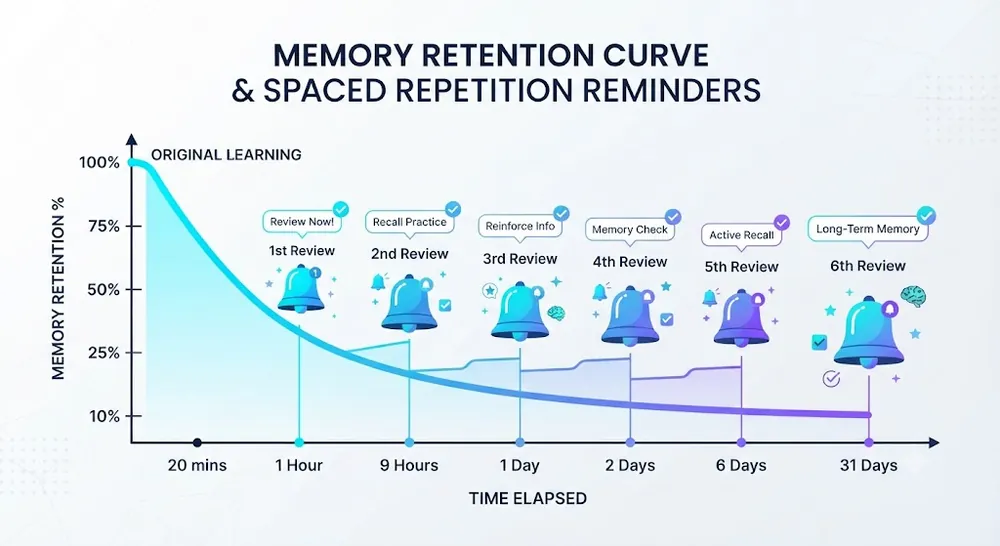
In the 1880s, psychologist Hermann Ebbinghaus ran a set of memory experiments on himself, memorizing lists of nonsense syllables and testing how much he retained over time. What he found, since replicated in modern cognitive science research many times over, is now called the "forgetting curve": memory of newly learned information decays roughly exponentially unless it's reinforced. Most of what you learn in a study session is gone within a day or two if you never revisit it.
The intuitive response is to cram, review the material over and over, right up until the moment you need it. Cramming does work, briefly. But it's a shortcut that trades long-term retention for short-term recall. Because the review sessions are packed close together, they don't force the "extra effort" of retrieving something you'd almost forgotten, and it's specifically that effortful retrieval, right before you would have forgotten, that seems to strengthen memory the most. This is often called the "spacing effect," and it's one of the more robust, replicated findings in learning science.
Spaced repetition systems are built directly around this idea: instead of reviewing everything on a fixed daily schedule, you review each individual piece of information right around the time you're about to forget it. Get it right, and the system waits longer before showing it to you again. Get it wrong, and the system brings it back sooner. Over time, well-learned material gets reviewed less and less often, while shaky material gets more attention, which is a far more efficient use of study time than a blanket "review everything every day" approach.
What SM-2 actually does
The algorithm most spaced repetition software is still built on, including ours, is called SM-2, short for "SuperMemo 2." It was developed by Piotr Woźniak in the late 1980s as part of the SuperMemo project, one of the earliest attempts to formalize spaced repetition into software. Decades later, despite plenty of newer research (including SuperMemo's own later, more complex algorithms and the more recent FSRS model some apps now use), SM-2 remains widely used because it's simple, well-understood, and does the core job well.
Here's what it does, in plain terms, every time you review a card or question:
- You rate how well you remembered it, typically on a 0–5 scale, from "completely forgot" to "recalled it instantly and confidently."
- The system updates an "easiness factor" (EF) for that item, a running number that represents how easy that particular piece of information is for you personally. Every item starts at the same baseline easiness, and it drifts up or down slightly with every review depending on how well you did.
- The system schedules the next review based on that easiness and the review history. The first successful review sets a short interval (commonly 1 day), the second successful review a longer one (commonly 6 days), and every review after that multiplies the previous interval by the item's easiness factor, so well-known material stretches out to weeks, then months, between reviews.
- A poor rating resets the interval and nudges the easiness factor down, so the item comes back into more frequent rotation until it's genuinely stuck.
That's the whole idea: track how well you know each item individually, and let review frequency drift automatically based on real performance instead of a fixed calendar. It's a simple feedback loop, and it's why SM-2-family algorithms have stayed relevant for over 35 years even as more sophisticated statistical models have been developed.
Under the hood, our implementation follows this SM-2 pass-branch schedule almost exactly as originally specified: the easiness factor never drops below 1.3 (a floor that keeps even your weakest cards from spiraling into review-every-hour territory), the first two successful intervals are 1 day and then 6 days, and every interval after that is the previous interval multiplied by the current easiness factor, rounded to a whole number of days.
To be clear about what this is and isn't: this is the classic, published SM-2 algorithm, not FSRS (a newer, more statistically involved spaced-repetition model some apps have adopted), and not a proprietary in-house algorithm dressed up in marketing language. We picked it because it's transparent, well-studied, and it works. If we ever change the underlying scheduling model, we'll say so plainly, the same way we're saying plainly here what runs today.
The two things we actually added on top of it
Textbook SM-2 has a rough edge: it treats every failed review the same way, whether the item was brand new or something you'd already reviewed successfully a dozen times, and it typically just resets the schedule back to square one on a miss. We built two specific, narrow extensions on top of the standard algorithm to smooth that out.
Lapse tracking. If a card that's already been through at least two successful reviews, meaning you'd built up real, demonstrated familiarity with it, gets failed, the system flags it as a "lapse" rather than treating it identically to a brand-new item you're seeing for the first time. A card you used to know and then forgot is a meaningfully different situation from a card you've never really learned, and marking that distinction is the first step toward eventually treating the two cases differently in how they're re-taught, not just re-scheduled.
Intra-day relearn. The classic SM-2 approach to a failed review is to reset the schedule and let it work its way back up over subsequent days. Ours does something more immediate: a failed card is rescheduled just 10 minutes later, in the same session, instead of waiting for the next calendar day. The idea is straightforward, if you just got something wrong, the most useful moment to try again isn't tomorrow, it's a few minutes from now, once the correct answer has had a moment to sink in but before you've moved on to other material entirely. It's a small change, but it keeps struggling items in active circulation rather than parking them until the next day's session.
Both of these are described directly in the scheduling code itself, not bolted-on marketing language, the module's own internal description is "SM-2 with lapse tracking and intra-day retry support," which is exactly what it does: nothing more, nothing less.
Review ties directly into the reward system
One deliberate design choice: reviewing a spaced-repetition item earns experience points (XP) the moment you submit it, 5, 7, or 9 XP depending on how well you rated your recall, through the same points system that powers the rest of the platform's gamification. This isn't a separate "streaks app" bolted alongside a "flashcards app" that happen to share a login. Every review is logged, scored, and rewarded through the same underlying mechanism, so the daily habit of clearing your due reviews is reinforced the same way any other learning activity on the platform is.
Every item tracks its own easiness factor, interval, repetition count, and next due date, and every individual review is logged as its own record, including whether that review was a lapse, so the history of how you've learned (and occasionally forgotten and re-learned) each piece of material is fully visible, not just the current schedule.

Why this matters more than it sounds like it should
Spaced repetition isn't flashy. It's not a large language model, it's not a neural network, and there's nothing about it that will show up in a splashy demo video. What it is, is one of the few learning techniques with genuinely strong, decades-deep evidence behind it, and the difference between "spaced repetition" as a marketing buzzword and spaced repetition as an actually-implemented scheduling algorithm is exactly the kind of detail worth being specific about. When review timing is tied to a real, published algorithm rather than an arbitrary "review daily" reminder, and every review immediately feeds back into both your personal schedule and your progress in the app, the habit of coming back to material you're about to forget stops being a chore you have to remember to do and starts being the thing the system is quietly steering you toward, one card at a time.
If you want to see how this fits into the bigger picture, how spaced repetition connects to concept mastery tracking, streaks, and the rest of the platform, that's covered in the Spaced Repetition section of the teloriva platform overview, or in our explainer on why gamification plateaus if you want the reward-system side of the story.